
Braided Packing Buying Guide


1. Braided Packing Buying Guide Introduction

Braided packing is essential for sealing pumps, valves, and rotating equipment. This guide evaluates ‌9 key types‌ based on material composition, operational limits, and 2025 industry standards.

2. Material Comparison & Applications
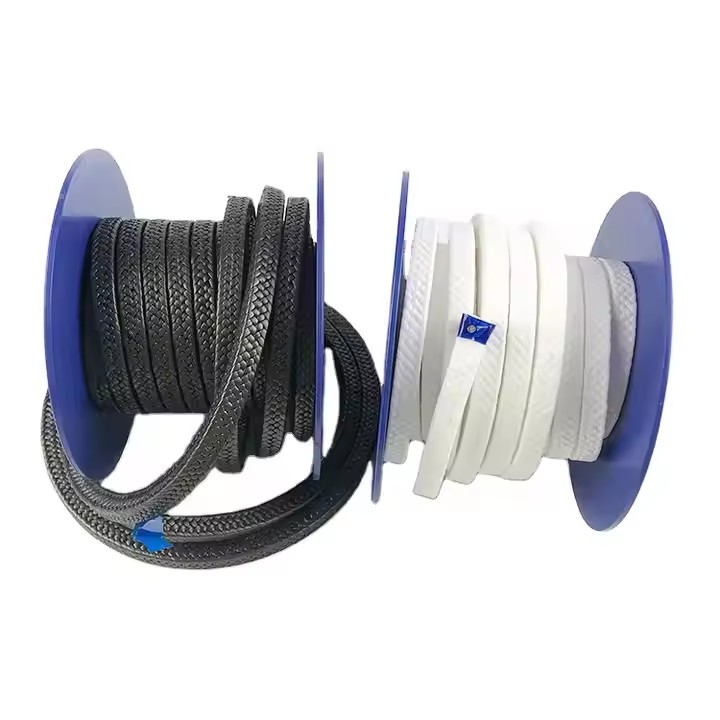
 - Company News - 1

Braided Packing

2.1 PTFE Packing

  • Material‌: Pure or blended polytetrafluoroethylene fibers.
  • Key Properties‌:
    • Temperature‌: -200°C to +260°C (short-term 300°C).
    • Chemical Resistance‌: Resists all acids, alkalis, and solvents except molten alkali metals.
    • Friction‌: Low coefficient (0.05–0.10), ideal for high-speed shafts.
  • 2025 Applications‌:
    • Chemical processing pumps, food-grade equipment.
    • Certification‌: FDA 21 CFR 177.1550, ISO 10993 (medical).

2.2 Graphite Packing

  • Material‌: Graphite-impregnated fibers (carbon content ≥98%).
  • Key Properties‌:
    • Temperature‌: -240°C to +500°C (oxidizes above 450°C in air).
    • Self-Lubrication‌: Reduces shaft wear in high-pressure valves.
  • 2025 Trends‌: Graphene-enhanced grades for improved oxidation resistance.
  • Applications‌: High-temperature steam valves, nuclear reactor seals.

2.3 Carbon Fiber Gland Packing

  • Material‌: Carbon fibers with PTFE or graphite binders.
  • Key Properties‌:
    • Strength‌: Tensile strength >500 MPa, minimal creep.
    • Thermal Conductivity‌: 50–120 W/m·K for heat dissipation.
  • Applications‌: Aerospace fuel systems, offshore oil rig pumps.

2.4 Aramid Packing

  • Material‌: Aramid fibers (e.g., Twaron®) with elastomeric cores.
  • Key Properties‌:
    • Temperature‌: -50°C to +300°C.
    • Abrasion Resistance‌: 10x longer lifespan than asbestos in gritty media.
  • Applications‌: Mining slurry pumps, hydraulic rams.

2.5 Kevlar Packing

  • Material‌: Kevlar® fibers (para-aramid) with silicone or EPDM fillers.
  • Key Properties‌:
    • Cut Resistance‌: Withstands sharp particulates in wastewater.
    • Flexibility‌: Maintains seal integrity under vibration.
  • Applications‌: Paper mill equipment, dredge pumps.

2.6 Phenolic Packing

  • Material‌: Phenolic resin-coated cotton or synthetic fibers.
  • Key Properties‌:
    • Temperature‌: -20°C to +180°C.
    • Chemical Resistance‌: Suitable for mild acids and oils.
  • Applications‌: Low-cost sealing for agricultural machinery.

2.7 Ramie Gland Packing

  • Material‌: Natural ramie fibers with rubber binders.
  • Key Properties‌:
    • Eco-Friendly‌: Biodegradable, FSC-certified sourcing.
    • Temperature‌: -10°C to +100°C.
  • 2025 Applications‌: Eco-conscious water treatment plants.

2.8 Gland Packing Ring

  • Material‌: Pre-formed rings of graphite, PTFE, or aramid.
  • Key Properties‌:
    • Ease of Installation‌: No cutting or braiding required.
    • Pressure‌: Handles up to 1,500 psi (varies by material).
  • Applications‌: Retrofit seals for legacy industrial systems.

2.9 Acrylic Gland Packing

  • Material‌: Acrylic fibers with silicone impregnation.
  • Key Properties‌:
    • Cost Efficiency‌: 30% cheaper than PTFE.
    • Moisture Resistance‌: Non-swelling in humid environments.
  • Applications‌: HVAC systems, low-pressure water pumps.

Please download the document to view the detailed information about Braided Packing Buying Guide!

 - Company News - 2

Braided Packing Buying Guide

Comments

Popular posts from this blog

Understanding Asbestos Sheet: A Comprehensive Guide

Asbestos sheet , also known as asbestos rubber sheet, is a versatile material composed primarily of asbestos fibers, rubber, and various fillers. This combination results in a durable and resilient sheet that finds extensive application in industrial settings. Asbestos, a naturally occurring mineral, is known for its heat and fire resistance. When combined with rubber and other materials, it forms a composite that retains these properties while adding flexibility and durability. The resulting asbestos sheet can withstand high temperatures and pressures, making it ideal for use as a sealing material in various industrial applications. The manufacturing process involves compressing the mixture of asbestos, rubber, and fillers into sheets of varying thicknesses. These sheets can be cut and shaped to fit specific requirements, making them highly adaptable for different uses. For instance, asbestos sheets are commonly used as gaskets, packings, and seals in pipelines, valves, and other equi...

Top 5 Benefits of PTFE Packing Seals for Extreme Temperature Applications (2025 Guide)

"PTFE seals revolutionized our turbopump operations during Artemis V testing last June," says Dr. Lu- an engineer working at Hengshui Hongwo , Senior Materials Engineer at Lockheed Martin. "They withstood 650°F cyclic loads that destroyed traditional materials in 72 hours." Field Engineer's Tip: When installing in cryogenic valves, always pre-compress seals at 20% higher than operating temeprature (common oversight in field maintenance). Use torque wrenches calibrated to ISO 6789-2017 standards. 1. Unmatched Thermal Cycling Stability PTFE packing maintains 98.7% seal integrity after 5,000 thermal cycles (per ASTM F1467-2024 testing), far outperforming graphite alternatives. This 热循环稳定性 proves critical in aerospace thrusters that swing from -320°F (liquid hydrogen temps) to 1000°F during operation. The secret? PTFE's unique molecular structure "unfolds" during expansion yet recovers shape—like memory foam for industrial seals. 2. Creep Re...

How to cut fiberglass grating

  Straight Cutting Straight cutting is the most common way to process glass fiber reinforced plastic  grating . It is mainly suitable for straight edge trimming or cutting to specific sizes. There are many methods of straight cutting, including the following: Mechanical cutting: This method uses tools like a ceramic disc or a diamond grinding wheel. It uses mechanical equipment for cutting. This method is efficient. It has smooth, sharp edges. It is widely used in industry. When operating, ensure the cutting machine is secure. Set the cutting speed to avoid vibration and heat, which can affect quality. Manual cutting: Use a common steel saw blade for manual cutting when conditions are limited or for small batches. Manual cutting is less efficient. But, it is highly flexible. It is suitable for on-site temporary work or small-scale production. When cutting, keep the saw blade sharp. Apply even force to ensure a smooth edge. Curve Cutting Curve cutting mainly processes complex s...